The Silicon Cold War: How Semiconductors Became the New Oil
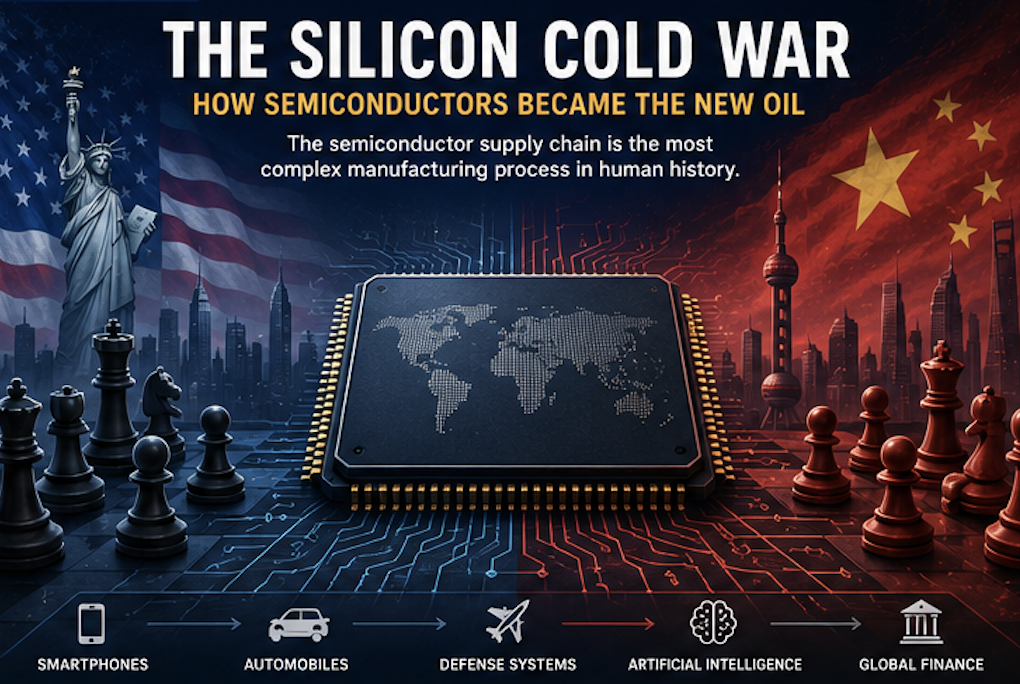

The Silicon Cold War: How Semiconductors Became the New Oil
For the past century, global power dynamics were heavily dictated by access to oil. Today, the foundation of modern geopolitical supremacy is built on something much smaller: silicon microchips.
From the smartphones in our pockets to hypersonic missiles, and from global financial markets to the explosion of generative Artificial Intelligence, every critical piece of modern infrastructure relies on semiconductors. However, the supply chain for these chips is incredibly fragile, leading to what many experts now call the “Silicon Cold War.”
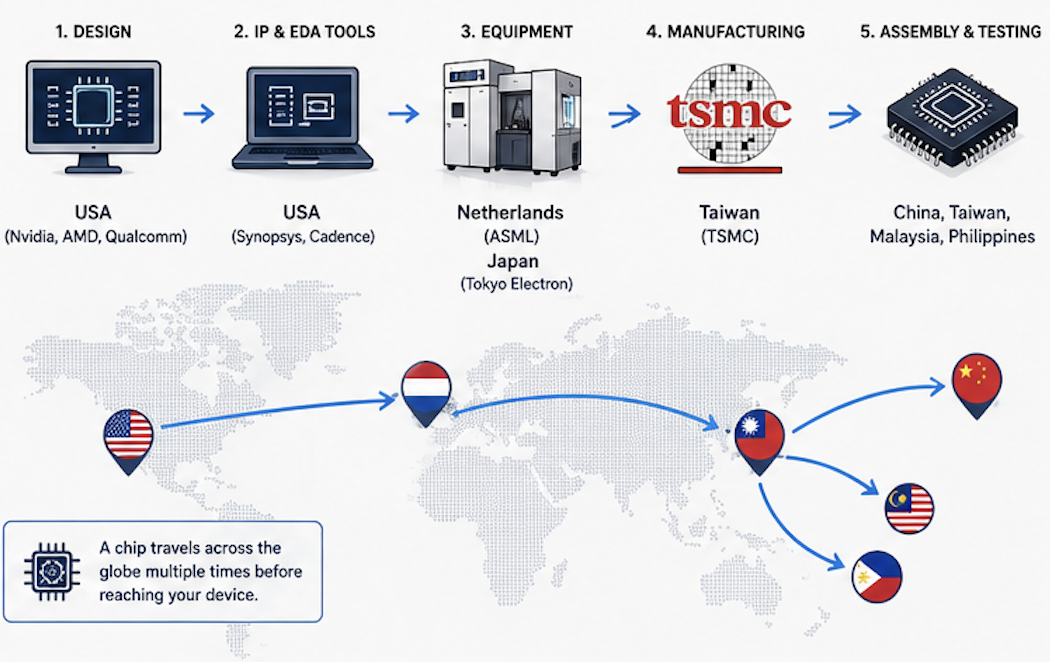
The Ultimate Choke Point: Taiwan
The most critical vulnerability in the global tech ecosystem is geographical concentration.
TSMC (Taiwan Semiconductor Manufacturing Company) produces over 90% of the world’s most advanced microchips. If a major geopolitical crisis were to disrupt production in Taiwan, the global economy would face an unprecedented catastrophe.
- Apple relies on TSMC for its iPhone processors.
- Nvidia relies on TSMC for the GPUs that train the world’s AI models.
- Automakers rely on older chips produced in the region to build modern vehicles.
Because of this extreme reliance, semiconductors have become a vital aspect of national security for both the United States and China.
The Machine That Makes the Chips: ASML
While Taiwan handles the manufacturing, the ability to build advanced chips depends on a single company in the Netherlands: ASML.
ASML has a global monopoly on Extreme Ultraviolet (EUV) lithography machines. These machines, which cost over $200 million each and are shipped in multiple Boeing 747s, use lasers to etch microscopic transistor patterns onto silicon wafers.
Without ASML’s technology, the advancement of Moore’s Law—and by extension, the advancement of AI—comes to a halt. Recognizing this, the U.S. government has heavily lobbied the Dutch government to restrict the export of ASML’s most advanced machines to rival nations, effectively using technology as a geopolitical weapon.
The AI Arms Race
The geopolitics of semiconductors is no longer just about consumer electronics; it is fundamentally about Artificial Intelligence.
The nation that leads in AI will have massive economic and military advantages. AI systems require tens of thousands of advanced GPUs to train. By controlling the flow of advanced semiconductors, nations are attempting to control the speed of AI development globally.
The U.S. CHIPS and Science Act and Europe’s European Chips Act are multi-billion dollar efforts designed to bring semiconductor manufacturing back to the West. However, replicating the highly specialized ecosystems of East Asia will take decades, if it is even possible.
What Happens Next?
We are entering an era of “techno-nationalism.” The open, globalized supply chains of the 1990s and 2000s are being fractured into distinct, allied technology blocs.
For engineers and technology professionals, this geopolitical shift has profound implications:
- Supply Chain Redundancy: Software and hardware architectures must be designed to withstand sudden supply chain shocks.
- The Rise of RISC-V: Open-source chip architectures like RISC-V may see accelerated adoption as nations seek alternatives to proprietary designs controlled by foreign entities.
- Hardware Efficiency: As access to the most advanced chips becomes restricted or expensive, the software engineering focus will shift dramatically toward algorithmic efficiency and writing performant code.
The 21st century will not be defined by who controls the land or the sea, but by who controls the silicon.
