Code as Free Speech: India's Bitchat Crackdown and the Future of P2P Regulation
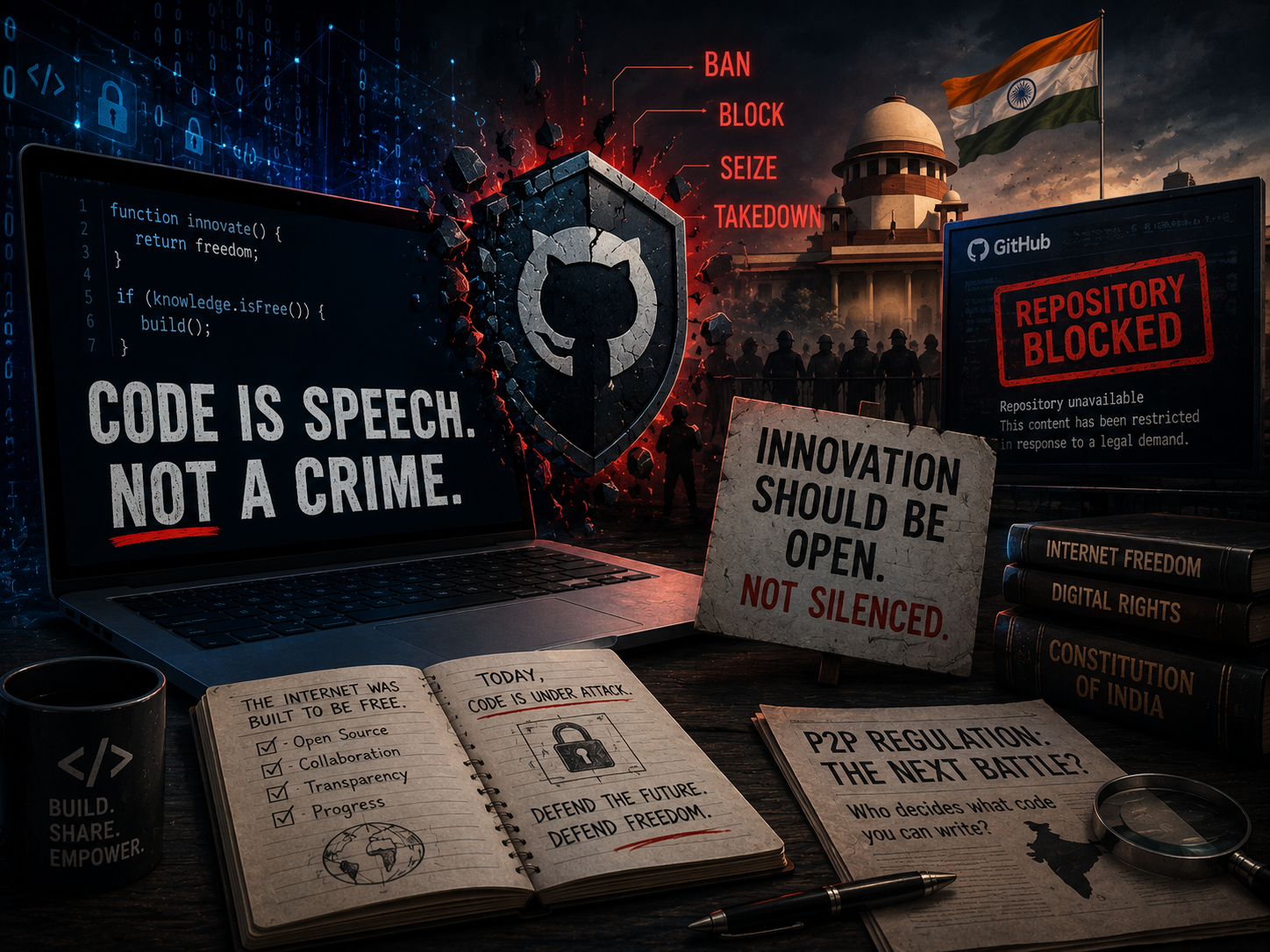

The flashpoint arrived quietly through a bureaucratic notice, but its implications echo loudly across every developer’s terminal. During intense student-led protests and sweeping localized internet shutdowns in New Delhi, an offline, Bluetooth-powered messaging app called Bitchat—associated with Jack Dorsey—saw an unprecedented surge. India quickly accounted for roughly 85% of Bitchat’s global downloads between July 17 and July 23, with daily active users in the country soaring past 330,000 and overall downloads jumping thirty-two-fold on July 19 alone.
Faced with an information vacuum they could no longer control through traditional cellular throttling or broadband blocks, authorities took an extraordinary step. The Ministry of Home Affairs, via the Indian Cyber Crime Coordination Centre (I4C), issued an urgent notice directed at GitHub, demanding the restriction of access to three core Bitchat repositories within a strict three-hour window.
This was not a routine request to take down a specific defamatory post, an illegal video, or a terrorist propaganda channel. This was an order to vaporize the source code of an entire software project. It marks a fundamental, alarming shift in internet governance: moving away from regulating harmful content and toward criminalizing foundational software architecture. For software engineers, open-source maintainers, and legal technologists, this moment forces an uncomfortable reckoning with a new reality where writing code can be construed as a direct challenge to state authority.
Anatomy of a Mesh Messenger: How Bitchat and P2P Networks Bypass Infrastructure
To understand why a state apparatus would target a GitHub repository rather than a centralized server, we have to look closely at how modern peer-to-peer (P2P) mesh networking works. Traditional messaging apps like WhatsApp, Telegram, or Signal—despite their end-to-end encryption—rely fundamentally on centralized or federated infrastructure. Messages must traverse internet gateways, push notification services (like Apple’s APNs or Google’s FCM), and centralized relay servers. When a government wants to silence a region, it orders internet service providers to pull the plug, severing the connection between the user’s device and those central servers.
Mesh messengers like Bitchat and projects like Briar operate under a completely different paradigm. They strip away the reliance on traditional telecommunication infrastructure entirely. Instead of routing packets through cellular towers and fiber-optic cables, they leverage local hardware capabilities—specifically Bluetooth mesh networking and Wi-Fi Direct—to form ad-hoc, localized communication grids.
| Feature | Traditional Client-Server Apps (e.g., WhatsApp) | P2P Mesh Networks (e.g., Bitchat) |
|---|---|---|
| Network Dependency | Requires active internet (Cellular/Wi-Fi) | Operates completely offline / local radio waves |
| Infrastructure | Centralized or federated servers and routers | Decentralized device-to-device relay |
| Censorship Vector | Easily blocked via ISP throttling or server blocks | Extremely resilient; requires physical device seizure |
| Data Routing | Direct client-to-server connection | Multi-hop forwarding across nearby peers |
In a Bluetooth mesh network, every smartphone acts not just as an endpoint, but as a router. When Alice wants to send a message to Bob, but Bob is out of direct Bluetooth range, Alice’s device transmits the encrypted packet to Charlie’s device standing nearby. Charlie’s device receives the packet, validates the routing headers without being able to read the payload (thanks to P2P encryption), and passes it along to the next node until it reaches Bob.
This multi-hop architecture makes localized internet shutdowns remarkably ineffective. The more people who use the app during a protest or blackout, the denser and more robust the mesh network becomes. Because there is no central server, there is no single point of failure to bomb, subpoena, or block at an ISP level. The only way for an authority to stop the flow of information in a pure mesh network is to eliminate the software primitives at their source—the public code repositories where developers collaborate to build them—or to confiscate every physical device in the streets.
The Legal Frontier: Section 69A vs. Open-Source Repositories
The legal mechanics behind the takedown notice reveal a profound mismatch between twentieth-century regulatory frameworks and twenty-first-century software development. In India, online content moderation and censorship requests have traditionally relied on Section 69A of the Information Technology (IT) Act, alongside the 2009 Information Technology (Procedure and Safeguards for Blocking Access of Information by Public Users) Rules.
Historically, Section 69A was designed to target specific, identifiable pieces of unlawful content that threaten sovereignty, integrity, defense, security, or public order. A government official or agency identifies a specific URL, a hosted webpage, a tweet, or a media file, issues a blocking order to an intermediary (like an ISP, a social media platform, or a cloud host), and the specific content is rendered inaccessible within that jurisdiction.
Traditional Path (Section 69A):
[Unlawful URL/Post] ---> [Government Notice] ---> [Intermediary Blocks Content]

The Bitchat Shift:
[Source Code Repository] ---> [Government Notice] ---> [Platform Suppresses Architecture]
Targeting Bitchat’s GitHub repositories breaks this legal mold entirely. Source code is not “content” in the traditional legal sense; it is a set of logical instructions, a blueprint, a medium of expression, and mathematical formulation. By demanding the removal of Bitchat repositories, the I4C made an aggressive legal leap: treating dual-use software architecture as inherently unlawful if its functionality can be leveraged to bypass state surveillance or communication blackouts.
This creates a chilling precedent for open-source maintainers globally. Most decentralized tools—ranging from Tor and Signal components to basic encryption libraries—are inherently dual-use. They can be used by privacy advocates, journalists, and dissidents, but theoretically, they can also be used by malicious actors. If a government can legally compel a global platform like GitHub to purge a repository simply because the resulting software allows offline, uninterceptable communication during civil unrest, the foundational legal protections of open-source software development begin to crumble. It transforms code hosting platforms into de facto enforcement arms for local censorship, forcing maintainers to either self-censor or risk legal annihilation.
Digital Sovereignty and the Paradox of State-Mandated Interception
At the heart of these crackdowns lies a fundamental ideological clash between digital sovereignty—interpreted by states as absolute territorial control over data and communications—and absolute privacy architectures.
Modern nation-states rely heavily on attribution and traceability. Effective law enforcement, intelligence gathering, and public order management depend on the state’s ability to identify who said what, when, and to whom. Traditional telecommunications and centralized digital services are built with compliance baked into their core architecture. They maintain access logs, metadata records, phone numbers, and KYC (Know Your Customer) details that can be subpoenaed instantly.
Decentralized, zero-knowledge, and P2P architectures represent an existential threat to this compliance model. They are structurally designed to eliminate backdoors, central log repositories, and metadata harvesting. When a protocol uses decentralized encryption and multi-hop mesh routing, it inherently strips away the state’s ability to perform lawful interception. There is no central server to subpoena; there are no traffic logs to demand.
This friction mirrors ongoing debates around user privacy under extreme legal pressure. When a state demands access to encrypted data, developers often implement cryptographic defenses that push back against state overreach. For instance, exploring mechanisms like those discussed in our analysis of duress password compliance highlights how engineering solutions attempt to balance personal safety with legal demands. However, mesh apps like Bitchat bypass the need for compromise entirely by making interception technologically impossible rather than just policy-restricted. To a government agency tasked with maintaining public order during a crisis, a communication tool that cannot be tapped or monitored is indistinguishable from a threat to national security.
Global Ramifications: Developer Freedom Under Threat
The incident in New Delhi is not an isolated legal anomaly; it is a stress test for the global open-source software ecosystem. GitHub, owned by Microsoft, is an American corporation operating under United States jurisdiction, yet it routinely complies with geo-blocking and content removal requests from international governments to maintain market access.
When a state agency in India issues a three-hour ultimatum to a platform hosted in San Francisco, it exposes the profound vulnerability of centralized code hosting. If a platform chooses non-compliance, it risks getting completely blocked within a major national market, cutting off millions of developers. If it complies, it sets a dangerous global precedent where any authoritarian or democratic state can use threats of market exclusion to scrub software repositories it dislikes from the global internet.
This dynamic is rapidly changing how developers think about software distribution and version control. We are witnessing the nascent stages of a defensive pivot within the open-source community:
- Decentralized Git Mirrors: Developers are increasingly hosting redundant code mirrors on federated platforms (like Forgejo or Gitea instances) and decentralized networks (like Radicle or IPFS).
- Censorship-Resistant Distribution: Reliance on a single central monopoly for open-source collaboration is being viewed as an architectural risk, prompting projects to distribute signed code bundles across multiple independent nodes.
- Maintainer Jurisdictional Awareness: Open-source maintainers are waking up to the reality that writing code is a political act, forcing them to consider where their repositories are hosted and what legal protections apply to their work.
When code repositories can be summarily erased by administrative fiat, the safety net that allowed the global open-source revolution to flourish over the past three decades begins to fray.
Future Outlook: The Inevitable Collision of Mesh Tech and Regulation
The confrontation over Bitchat is merely the opening salvo in a long-term ideological and technical war. As civil unrest, economic instability, and climate-induced disruptions increase globally, governments will increasingly face situations where traditional internet shutdowns fail to quell the flow of information. Consequently, the legal battles over mesh networking apps, encryption standards, and open-source code liability will define the next decade of digital rights.
We are heading toward a systemic collision between constitutional protections for free speech and state imperatives for digital control. Legal scholars and civil liberties organizations will inevitably challenge the categorization of source code as regulatable content under outdated statutes like Section 69A. Meanwhile, software engineers will continue to iterate on censorship-resistant primitives, embedding resilience directly into the network stack.
The future of digital sovereignty hangs in the balance. If code can be legally suppressed because of its inherent utility in evading state surveillance, the foundational premise of an open, permissionless internet ceases to exist. Preserving developer freedom requires recognizing that writing software—even software that challenges state power—is a vital form of protected expression. As engineers and technologists, our responsibility is to build systems that respect human autonomy, ensuring that the architecture of our future remains resilient against the shifting whims of regulatory control.
